

About us
Kaleidoscope Fruit Ranch is a family-scale orchard, specializing in certified organic Spartan, Ambrosia, Gala, and Pink Lady apples.
We also grow small quantities of certified organic cherries, apricots, peaches, table grapes, hardy kiwi, quince, and pears. See our Sales page for more information on availability.
Our goal is to continue growing food into the future and to ethically steward the land we farm on.
Some of our current and future planting projects include:
Hardy kiwis: Geneva, Ken’s Red (planted in 2021)
Table grapes: Coronation (planted 2023)
Pears: Bosc, Anjou (planted in 2023)
Seabuckthorn (trial begun spring 2023)
Walnuts (planted fall 2023)
More pears: Crimson Calais, Abade Fetale, Bosc, Anjou (planted spring 2024)
Apples: Airlie Red Flesh (planted spring 2025)
Our fruit ranch wraps around the edge of a precarious, sage-covered clay bank in Summerland, BC, within the Okanagan Valley fruit growing region.
In November 2025, Kaleidoscope Fruit Ranch became a member of the LocalMotive Farmers Network Co-operative, a non-profit organization associated with the Okanagan Food and Innovation Hub. Together, we are proactively working to build a resilient food system from the bottom up.

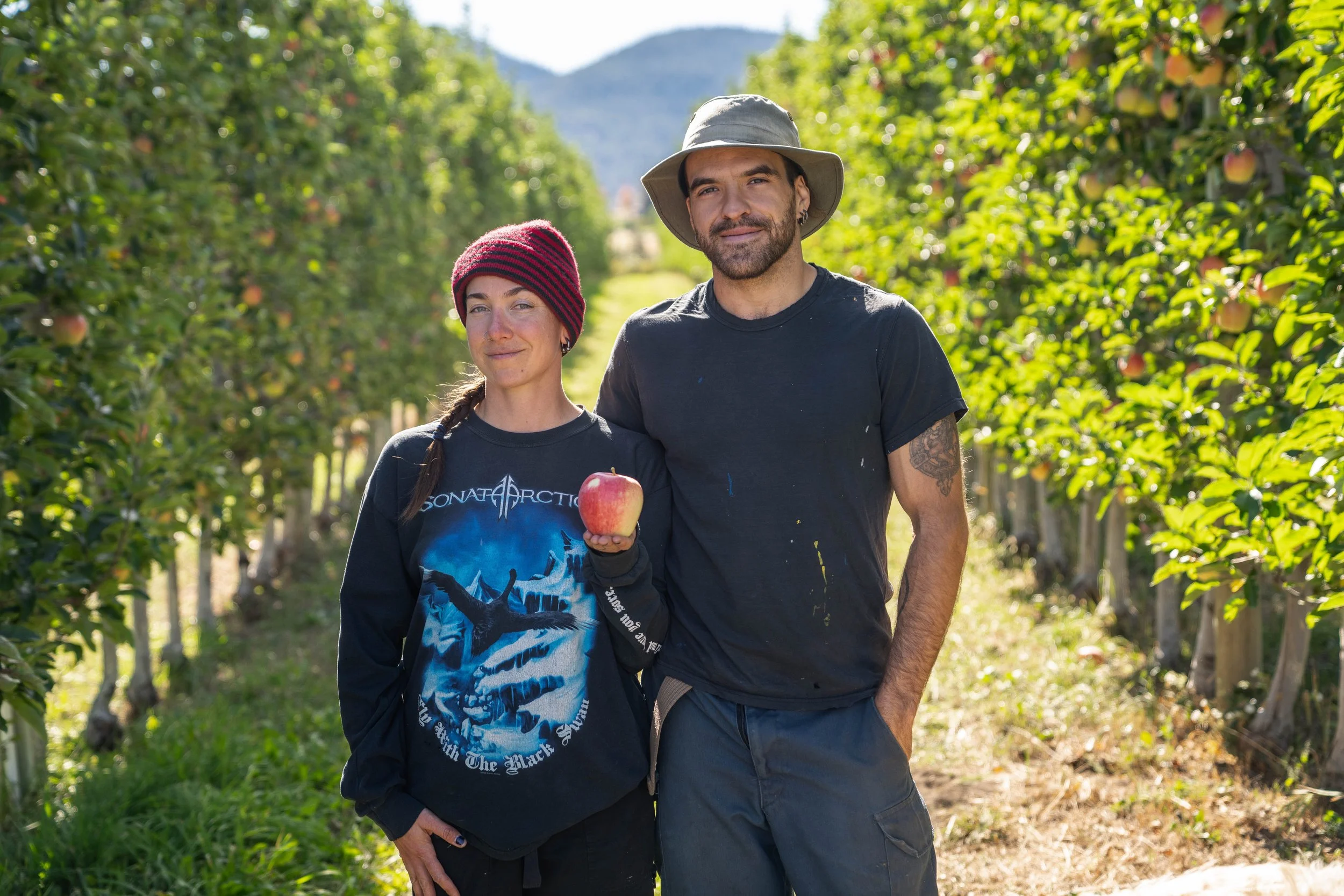
Fruit Ranchers Katie Sardinha and Devon Scott-Leslie during the second pick of Ambrosia, October 2025. Photo by Chris Stenberg.
“Family-scale” means that our orchard is sized and designed to provide a reasonable workload for us, together with one or two seasonal employees.
Farming only 10 acres makes it possible for us to maintain a high degree of knowledge of what is going on in our orchard. We make use of this knowledge to develop targeted, proactive, and precise solutions to pest and nutrient issues. This is how we do our best to respect the sensitive ecology of our diverse landscape.
While we do most of the farm labour ourselves, we typically hire one or two people to help us during thinning and harvest. Because our labour force is small and local, food production on our farm is relatively resilient to large-scale systemic shocks, which can disrupt the imported labour supply required on large farms. This is one reason why family-scale farms are integral to our regional food system.
The basis of organic agriculture is healthy soil.
“Healthy soil” is complex soil that supports a diverse microbial community. This microbial community, in turn, helps our trees obtain the water and nutrients they need to grow. Once a soil system has reached a healthy state, nutrient cycling can take place with minimal outside intervention. Getting to this healthy soil state is Goal #1 in organic tree fruit farming.
Goal #2 in organic tree fruit farming is promoting biodiversity on the farm. A more biodiverse farm system supports more pollinators and pest-controllers; these, in turn, improve pollination and prevent any given pest population from getting out of control. The more diversity is present in the farm ecosystem, the better! This, by the way, is why in organic farming we (almost) never aim to eliminate all of a given pest! If we did, what would that pest’s predators eat? Instead, we generally aim to reduce pest populations to below a threshold that is economically significant.
When pest populations do exceed that threshold, we use an Integrated Pest Management strategy to reduce the pest’s abundance.
Organic farming is kind of like ecological engineering. The more beings we recruit from the natural world to help us, the more benefits we see.

Devon and Loki transporting compost.

Julie Sardinha, one of our mentors
Kaleidoscope Fruit Ranch is PACS certified organic (PACS #16-831). In order to maintain this certification, our farm undergoes a rigorous annual audit process in which we demonstrate our ongoing compliance with the Canadian Organic Standards.
